

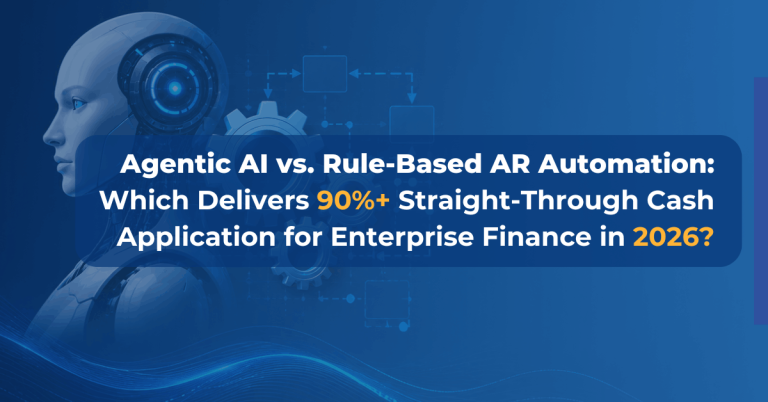
Rule-based AR automation gets enterprise finance teams to a plateau, not a finish line. Here’s the mechanical reason agentic AI clears the ceiling that static matching rules can’t. .
98%
Reconciliation accuracy in under 2 minutes at Tata Teleservices, ₹4,500 Cr+ processed annually
Source: Global PayEX, TTSL case study
90%
Reduction in manual reconciliation effort at Britannia — a six-member team’s work, now minutes
Source: Global PayEX, Britannia case study
Introduction
A rule-based cash application engine gets an enterprise AR team most of the way there: clean remittances, standard formats, one-to-one invoice matches, and then it stops. Every exception, every split payment, every deduction bundled into a lump-sum wire becomes a manual touch. At Fortune 500 volumes, with thousands of remittances landing in dozens of formats across multiple ERPs, that plateau becomes a structural ceiling: match rates stall in the 60 to 80% range no matter how many rules get added, because rules can only encode exceptions someone has already seen. Agentic AI approaches the problem differently. It reasons through unmatched cases the way a skilled analyst would, and that difference separates teams stuck at 75% straight-through processing from teams clearing 95%+.
What Is Rule-Based AR Automation, and Where Does It Break Down at Enterprise Scale?
Rule-based cash application software works by encoding a fixed set of if-then logic. If the remittance reference number matches an open invoice number, post the payment. If the amount matches exactly, close the line. If neither condition is met, route to a manual queue. This handles the easy 60 to 70% of payments well, where a customer pays one invoice with one remittance in a predictable format. It’s fast to deploy, easy to audit, and needs no ongoing model training.
The problem is what happens outside that easy majority. Enterprise AR teams deal in partial payments, bundled deductions, commission netting, short-pays for damaged goods, and remittances arriving as scanned PDFs, freeform emails, or marketplace-specific formats that change without notice. A rules engine has no mechanism for a case it hasn’t been explicitly programmed for. Every new exception requires a developer to write, test, and deploy a new rule, and by the time that cycle completes, three more format variations have appeared.
📊The ceiling is structural, not a tuning problem.
Rule-based systems plateau because their logic is enumerative: every match type must be explicitly defined in advance. Enterprise AR environments generate remittance variety faster than rules teams can encode it.
Source: industry pattern observed across enterprise AR deployments.
The remaining 25 to 40% isn’t a smaller version of the same problem. It’s a different class of problem entirely.
What Does Agentic AI Actually Do Differently in Cash Application?
Agentic AI doesn’t wait for a rule to exist. It reasons through the exception in real time. An agentic matching engine evaluates a payment the way an experienced analyst would: checking reference numbers, then amounts, then payment history, then likely deduction reasons, then partial-match probability across open invoices, all without a human defining each step in advance.
Agentic AI
Remittance in
any format
AI evaluates
multi-factor
Learns pattern
reuses past fix
Posts to ERP
no manual entry
Rule-based automation
Remittance in
any format
Checks rule
ref or amount
Rule fails
new pattern
Manual queue
human rework
It reads unstructured remittance data the way a person does, not the way a template does. A genuinely agentic engine auto-extracts payment and remittance data across PDFs, Excel files, scanned images, and emails, identifying short-payment reasons directly from freeform text. That single capability eliminates one of the largest sources of manual touches in enterprise AR: the payment nobody can identify.
It learns from every resolved exception instead of requiring a rule change. When the system meets a pattern it hasn’t seen cleanly before, a customer deducting a specific commission percentage, or a marketplace bundling chargebacks into one line, a continuous learning loop captures the resolution and applies it next time, with no developer writing new logic.
It takes action across systems, not just inside a matching queue. A rules engine flags a match and stops. An agentic system identifies the match, categorizes the deduction, routes it for approval, and posts the knock-off directly into the ERP, with no human re-entering the transaction.
Head-to-Head: Agentic AI vs. Rule-Based AR Automation
| Capability | Rule-Based AR | Agentic AI |
|---|---|---|
| Matching logic | ✗Fixed if-then rules, enumerated in advance | ✓ML-driven reasoning across reference, amount, and payment history |
| Handling new remittance formats | ✗Requires new rule + deployment cycle | ✓Auto-reads PDFs, Excel, email, scanned formats natively |
| Typical straight-through rate | ✗Plateaus around 60–75% at enterprise scale | ✓95%+ straight-through cash posting |
| Exception handling | ✗Routes to manual queue, no learning | ✓Continuous learning from resolved cases |
| Deduction categorization | ✗Manual mapping to reason codes | ✓Auto-categorized and routed to approval workflows |
| ERP posting | ✗Often requires manual re-entry after match | ✓Direct, automated knock-off posting to ERP |
| Scalability with volume growth | ✗Rule complexity grows faster than coverage | ✓Model improves with more transaction volume |
| Audit trail | ✗Simple, transparent logic | ✓Full audit trail with document reference capture |
⚠️ The rule-based ceiling is the single most expensive line item most CFOs never see on a P&L. Every point below 90%+ straight-through processing represents recurring headcount spent re-doing work a matching engine should have finished, and that gap compounds every reconciliation cycle, every quarter, indefinitely.
Why 90%+ Straight-Through Cash Application Changes the Working Capital Equation
Straight-through processing rate is a direct multiplier on how much of the AR team’s time goes toward productive work versus rework. A team stuck at a 70% match rate is structurally capped, because 30% of every incoming payment batch requires a human to manually investigate, categorize, and post. Cross the 90%+ threshold and the math inverts: the team stops being a processing bottleneck and becomes a capacity source for dispute resolution, payment-behavior analysis, and forecasting.
🧮 The straight-through processing multiplier:
Manual Touch Volume = Total Remittances × (1 − STP Rate)
At 70% STP, a team processing 10,000 monthly remittances still touches 3,000 manually. At 95%+ STP, that same team touches roughly 500, a 6x reduction in manual workload at identical volume, without adding headcount.
Faster, more accurate cash application also improves the accuracy of the cash position finance leaders forecast against, because unapplied and misapplied cash stops distorting the receivables ledger.
What Enterprise CFOs and AR Leaders Should Ask Every Cash Application Vendor
◆ What is your actual straight-through processing rate, measured how, and over what volume?
Ask whether that number reflects clean, standard-format payments only, or the full mix your business receives.
◆ How does the system handle a remittance format it has never seen before?
This is the best test for whether a platform is genuinely agentic or simply rules-based with a larger rule library.
◆ Does matching stop at identification, or does it complete the posting cycle?
A platform that only identifies a match has automated half the workflow.
◆ What happens to deductions and disputes?
Cash application and deduction management are inseparable in real B2B environments.
◆ How long does implementation take, and what does it require from IT?
Be wary of multi-quarter timelines for a data-matching problem.
◆ Can the vendor name a customer at your scale and ERP environment, with verifiable numbers?
What This Means for Your AR and Finance Team
The shift to agentic cash application changes what the AR team’s day looks like, not just how fast it moves. Reconciliation stops being the job and starts being the input: analysts spend less time keying data and more time on the exceptions the system genuinely couldn’t resolve, the ones needing human judgment anyway. Deduction and dispute resolution becomes proactive instead of reactive, since live dashboards surface bottlenecks before they age into write-offs. None of this happens without real process redesign alongside the software; the tooling alone doesn’t rewrite how approvals move between departments.
Meet AlgoriQ: Global PayEX’s Agentic AI Cash Application Engine
Everything above describes agentic cash application in principle. In practice, Global PayEX built one of these engines: AlgoriQ, an AI-powered platform designed to reason through exceptions and post straight through to ERP without manual intervention.
• Auto-reads remittance advice and bank statements across PDF, Excel, email, and standard bank formats, extracting short-payment reasons from source documents.
• Runs AI-driven matching across invoices, receipts, and remittance advice, extendible to complex deduction scenarios, with a full audit trail.
• Posts straight through to major ERPs, including SAP, Oracle, and Dynamics 365, without manual re-entry.
• Manages deductions natively, categorizing and routing them for approval instead of a spreadsheet handoff.
See how a 95%+ straight-through cash posting rate would change your AR team’s capacity.
▶Request a demo of AlgoriQWhere This Has Worked at Enterprise Scale
Case study · Telecom · India
Tata Teleservices: ₹125 Cr Unlocked Through Zero-Touch AR
98% reconciliation accuracy in under 2 minutes
Before: Posting cycles at TTSL extended up to two weeks, with fragmented manual processes limiting real-time cash visibility across a high-volume, multi-channel receivables environment.
What changed: Global PayEX implemented AlgoriQ integrated with TTSL’s Kenan and SAP systems, adding UTR validation and tax reconciliation alongside a self-service portal for 730K+ active users.
Results:
- ✓98% reconciliation accuracy in under 2 minutes
- ✓₹4,500 Cr+ processed annually with straight-through posting
- ✓7 to 10 day DSO reduction and ₹125 Cr in working capital unlocked
What Enterprise Reviewers Say on G2
★★★★★5/5
Enterprise (1,000+ employees) · Validated Reviewer · November 2023
“AlgoriQ has significantly streamlined our cash reconciliation and deductions management, resulting in substantial time savings. Previously, the reconciliation process spanned between 3-5 days involving 4 resources, but with AlgoriQ’s implementation, with its AI-driven…”
Vinay Kumar G., verified G2 reviewer
Read more Global PayEX reviews on G2 →Frequently Asked Questions
What is agentic AI in accounts receivable?
Systems that autonomously reason through payment matching, deduction categorization, and ERP posting without a human pre-defining every exception as a rule, learning from resolved cases over time.
What is straight-through cash application?
The automated matching and posting of incoming payments to open invoices with no manual intervention, from capture to ERP posting.
How is agentic AI different from rule-based AR automation?
Rule-based automation matches against fixed, pre-programmed conditions and routes anything else to a manual queue. Agentic AI reasons through unmatched cases using learned patterns and acts on its own.
What straight-through processing rate should enterprise finance teams expect?
Rule-based systems commonly plateau in the 60 to 75% range. AI-driven platforms like AlgoriQ are built to achieve 95%+ straight-through cash posting.
How long does implementation typically take?
Standardized payment advice environments can go live in as little as two weeks, with IT involvement limited to providing access to the open AR extract and bank payment files. .
Does agentic cash application software work with SAP, Oracle, and other major ERPs?
Yes. AlgoriQ integrates with major ERPs, including SAP, Oracle, Dynamics 365, Acumatica, and Sage, posting matched payments directly to the general ledger.
Conclusion
The gap between rule-based and agentic cash application isn’t a matter of degree. It’s a different category of system entirely. Rules encode what a team already knows how to handle; agentic AI handles what a team hasn’t seen yet, and improves with every transaction. For finance leaders still measuring success by how many rules their team wrote this quarter, the better question is different: how much of your AR team’s capacity is still spent redoing work a matching engine should have finished the first time? Global PayEX built AlgoriQ to answer that question directly, and the results above are what happens when enterprise teams stop treating reconciliation as a queue to clear.
See how a 95%+ straight-through cash posting rate would change your AR team’s capacity.
▶Request a Demo of AlgoriQ