


Summary/Executive Overview
Short payments are a frequent yet significant challenge for finance teams. The complexity of dealing with repeated short payments, unclear remittances, and manual follow-ups not only burdens them but also impairs the financial health of the business. This results in an extended DSO, slower cash conversion cycles, and ultimately, lost revenue.
Global PayEX offers a structured solution, designed to automate deduction management and streamline the process of dispute resolution in accounts receivable. By leveraging AI-assisted matching, it helps finance teams capture remittance data accurately, auto-categorize deductions, and route exceptions to the right owners for swift resolution. The result is a significant reduction in write-offs, faster resolution of discrepancies, improved DSO, and cleaner financial data.
What Is a Short Payment in Accounts Receivable?
According to recent industry research, 39% of B2B invoices in the US are paid late, and 81% of businesses have seen an increase in delayed payments.
Short payments occur when customers pay less than the full amount of an invoice. Short payments are often a result of mismatched remittances or application of credit notes, but they can also stem from pricing discrepancies, shipping errors, and other operational issues.
Here are some common types of short payments:
- Underpayments/Partial Payments: The customer pays a portion of the invoice, but not the entire amount.
- Mismatched Remittances: The payment made does not align with the remittance advice, leaving the company with a balance to resolve.
- Credit Note Offsets: Customers apply a credit note (e.g., rebates, returns, or discounts) to reduce the invoice amount, leading to a short payment.
In practice, it’s important to differentiate between legitimate adjustments and unauthorized deductions. Legitimate adjustments, such as agreed-upon discounts, are valid and should be accounted for. However, any deduction that doesn’t have prior approval represents a short payment.
The consequences are significant:
- Revenue Leakage: Unaddressed short payments lead to uncollected funds, which directly impact company’s profitability.
- Cash Flow Uncertainty: Short payments contribute to cash flow issues, making it difficult for finance teams to forecast accurately.
- Inflated DSO: The longer it takes to resolve short payments, the higher the DSO, which reflects poorly on the company’s collection efficiency.
- Operational Inefficiency: AR teams spend valuable time following up on discrepancies, slowing down the financial close process and reducing productivity.
With the right solution, these inefficiencies can be addressed through automation. Companies using automated deduction management typically see a 10-15% reduction in bad debt write-offs.
Common Causes of Short Payments in AR
Research by Attain Consulting Group shows that approximately 90% of deductions are valid, with 60-80% related to trade promotions. However, the challenge lies in quickly identifying which deductions are legitimate versus unauthorized. Some common causes of short payments include:
Pricing and Contract Discrepancies
Pricing mismatches between the contract and invoice often lead to short payments. Errors in agreed prices or missed discounts cause customers to pay less than invoiced.
Freight, Logistics, and Surcharges Errors
Discrepancies in freight charges, additional surcharges, or logistics costs are often disputed, resulting in underpayments when the amounts are incorrectly billed or unclear.
Credit Notes, Returns, and Allowances
Unplanned credit notes, returns, or allowances can lead to discrepancies. While agreed-upon credits are valid, unauthorized deductions can result in short payments.
Tax/Withholding and Regulatory Adjustments
Withholding tax (WHT) or other regulatory deductions can lead to short payments. Misunderstandings about tax obligations often cause such deductions to go unaccounted for.
Payment Term Misinterpretation and Early-Payment Discounts
Misinterpretation of payment terms or missed early-payment discounts often results in partial payments that leave invoices underpaid.
Data Quality Issues: PO Mismatch, Quantity Differences, Duplicate Invoicing
Mismatched Purchase Orders, discrepancies in billed vs. received quantities, or duplicate invoicing are common data issues that lead to short payments when payments are made for incorrect amounts.
| Cause | Evidence | Typical Resolution Owner |
| Pricing and Contract Discrepancies | Pricing mismatch between the invoice and contract | Sales/Contract Management |
| Freight, Logistics, and Surcharges Errors | Incorrect freight charges or missing surcharges | Logistics/Shipping Department |
| Credit Notes, Returns, and Allowances | Unauthorized credit notes or unplanned returns | Finance/Accounts Payable |
| Tax/Withholding and Regulatory Adjustments | Incorrect withholding tax applied | Tax/Legal Team |
| Payment Term Misinterpretation | Payment made after the agreed-upon date | Sales/Accounts Receivable |
| Data Quality Issues | PO mismatch or duplicate invoicing | IT/Data Management |
The Traditional Way vs. An Intelligent Way to Handle Short Pays
Traditional methods of handling short payments are often slow, inefficient, and error-prone. Finance teams rely on emails, spreadsheets, and unstructured remittance data to track and resolve discrepancies. This process leads to delays, which, in turn, inflates DSO and disrupts cash flow.
In contrast, an intelligent, automated approach leverages advanced technologies, such as AI-driven categorization, to streamline the short-payment resolution process.
| Aspect | Traditional Way | Intelligent Way |
| Remittance Handling | Manual tracking and allocation of payments. | Automated payment matching to invoices using AI and machine learning. |
| Dispute Management | Manual follow-ups via emails, spreadsheets. | Automated dispute identification, routing, and resolution with reason codes. |
| Data Handling | Manual entry, data inconsistencies, slow reconciliation. | Real-time data normalization, AI-assisted matching, and automated reconciliation. |
| Approval Process | Slow, manual approval processes. | Rules-based routing with automated approvals and SLA tracking. |
| Resolution Time | On an avg. 15-30 days to resolve discrepancies. | Resolution in 2-5 days, with real-time exception handling and intelligent automation |
| ERP Integration | Manual posting and data entry. | Seamless ERP integration with automated data posting and updates. |
An intelligent, automated solution significantly reduces the time spent on manual reconciliation, minimizes errors, and accelerates short-pay resolution. By implementing AI-driven workflows, businesses can improve DSO, streamline operations, and recover revenue more efficiently, leading to better cash flow management.
A Step‑by‑Step Playbook: How to Handle Short Payment in Accounts Receivable
Short payments are a common source of friction in AR, causing revenue leakage and prolonged DSO. To resolve these exceptions quickly and transparently, a systematic approach is required that captures every remittance detail, automates matching, categorizes deductions accurately and routes them to the right team for resolution. To handle short payments effectively:
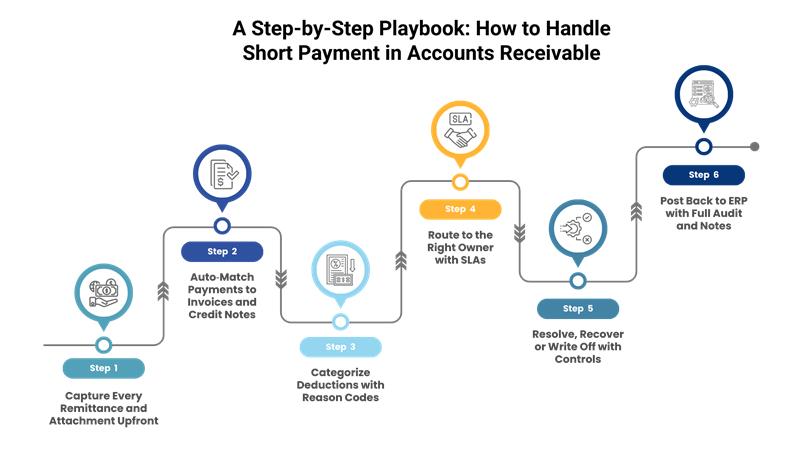
Step 1: Capture Every Remittance and Attachment Upfront
Begin by capturing all remittance advice and attachments the moment a payment arrives. This includes bank‑statement files, PDF remittances, email bodies and portal downloads. Leading deduction management platforms allow buyers to upload documents supporting deductions such as VAT, price variance or withholding tax. Normalizing formats up front prevents manual work later and creates a single source of truth for the payment context.
Step 2: Auto‑Match Payments to Invoices and Credit Notes
After capturing remittances, automate the cash‑application process. Use solutions that match payments to invoices at the line item level and accounts for partial payments, parent‑child invoice relationships and credit or debit‑note offsets. Advanced matching engines compare invoice numbers and amounts and reconcile payments across multiple rails (e.g., ACH, wires, card settlements). Auto‑matching short payments with their invoices reduces unapplied cash, flags discrepancies faster and frees staff from manual reconciliation.
Step 3: Categorize Deductions with Reason Codes
When a short payment is identified, classify the deduction using predefined reason codes. Typical categories include pricing disputes, freight or logistics errors, discounts, withholding tax (WHT), returns or allowances and promotional deductions. Some platforms map each deduction to ERP reason codes, enabling straight‑through processing. Standardized coding supports audit trails, prevents subjective classification and produces actionable analytics about short payment reasons in AR.
Step 4: Route to the Right Owner with SLAs
Deductions often originate in departments beyond finance. Pricing discrepancies should be sent to Sales or Contract Management; freight disputes to Logistics; tax‑related adjustments to the Tax team. Deploy workflow engines that automatically route each deduction to the appropriate owner with service‑level agreements (SLAs) for resolution. Clearly defined ownership and deadlines drive accountability and ensure that exceptions don’t languish across departments.
Step 5: Resolve, Recover or Write Off with Controls
Once routed, each deduction must be resolved. Valid claims such as contractual rebates or approved returns should be closed with credit notes or debit notes. Unauthorized deductions should trigger rebilling or collection of the residual balance. Having a formal dispute resolution process helps recover revenue and reduces write‑offs. When recovery is impossible, write‑offs should follow robust approval workflows and be documented for audit.
Step 6: Post Back to ERP with Full Audit and Notes
Finally, post the resolution back into your ERP, along with notes and supporting documents. Automated reconciliation tools post payments, credit notes and deductions to the ERP in real time and map reason codes for straight‑through processing. This eliminates manual re‑keying, keeps the general ledger clean and prevents month‑end surprises. A fully auditable trail ensures traceability and compliance.
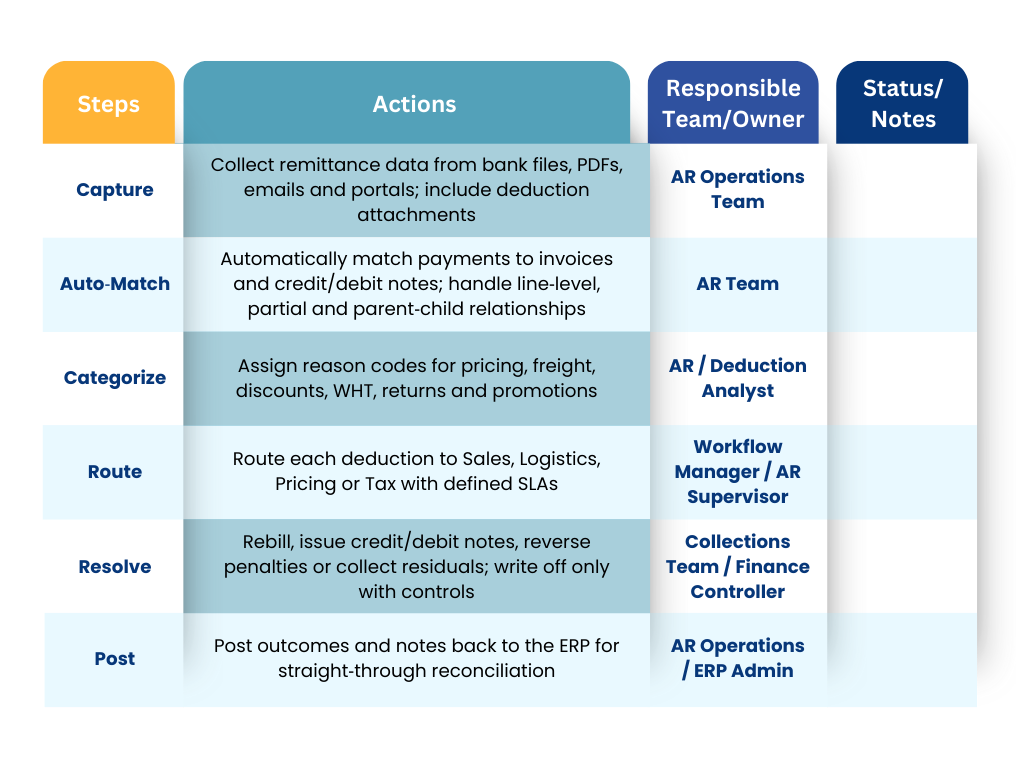
Use the Short Payment Resolution Checklist below to ensure your AR team follows a systematic approach in managing short payments, helping you streamline your processes and recover lost revenue more effectively.
How Global PayEX FreePay Accelerates Short‑Pay Resolution
FreePay, Global PayEX’s Electronic Invoice Presentment and Payment (EIPP) platform, automates the end‑to‑end management of deductions and disputes for complex B2B transactions. It combines remittance data capture, AI‑assisted matching and configurable workflows to speed short‑pay resolution and improve working capital. Below are the key capabilities that differentiate FreePay.
Deduction Management Layer Built for B2B Complexities
FreePay allows customers to declare deductions (for example VAT differences, price variances or WHT) when making a payment. Buyers upload supporting documents, and the system maps each deduction to ERP reason codes for straight‑through processing. FreePay offers over 150 configurable rules, including custom deduction types and multi‑dimension discount slabs. This ensures that corporate policies are enforced and that deductions are categorized consistently, eliminating guesswork and manual coding.
Dispute Resolution Workflows with Approvals
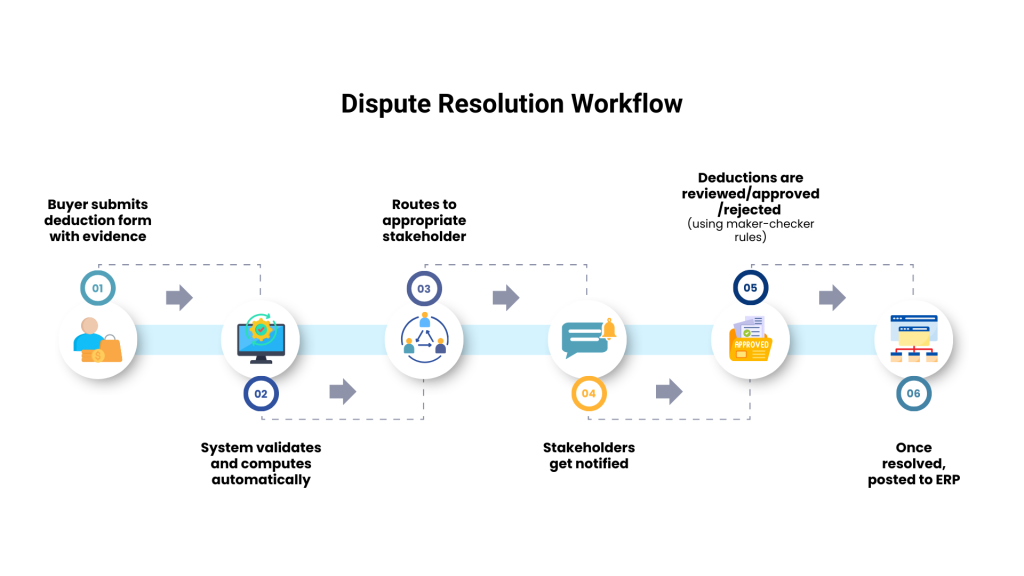
Once a deduction is logged, FreePay initiates an automated dispute resolution workflow. Buyers can submit forms through the portal with attached evidence; WHT or tax deductions are computed automatically and validated. FreePay implements maker‑checker rules so that deductions must be approved by the appropriate authority. Multi‑departmental workflows ensure deductions involving sales, logistics or tax teams are routed correctly. Automated notifications keep stakeholders informed, while audit trails provide transparency, reducing cycle times and preventing unauthorized credits.
Remittance Data Ingestion and Matching Logic
FreePay ingests remittances from emails, OCR-processed PDFs and bank feeds and reconciles them with open invoices. Its AI‑assisted cash‑application engine matches payments even without explicit remittance or when dealing with partial payments and credit/debit note offsets. The platform supports multiple payment rails (e.g., ACH, wires, cards) and bank statement formats (BAI2, MT940, CAMT), ensuring high match rates and reducing unapplied cash.
Direct Debits, Scheduled Pulls and Discount Computation
To prevent future short pays, FreePay offers flexible payment options. Customers can pay invoices in full or in part, apply credit notes and schedule automated payments. Multi‑channel notifications remind buyers of due dates, and scheduled pulls ensure that payments are debited on the correct date. FreePay also computes early‑payment discounts according to corporate policies, ensuring that net dues are accurate and preventing disputes over discount eligibility.
ERP Integration and 100 % Straight‑Through Reconciliation
Every action in FreePay including payments, credit‑note applications and dispute resolutions, is posted back to the ERP in real time. The platform maps deductions with ERP reason codes for straight‑through reconciliation, eliminating manual re‑keying and reducing month‑end rework. FreePay also reconciles payments across multiple banks and currencies, giving finance teams a unified view of customer accounts and improving data integrity.
Real-time Analytics for Root‑Cause and Prevention
FreePay provides dashboards and reports that slice and dice deduction data by buyer, SKU, region and reason code, enabling root‑cause analysis and preventive action. Finance leaders can monitor dispute cycle times, forecast the impact of deductions on DSO and identify patterns such as chronic pricing disputes or frequent freight adjustments. Dashboards that highlight top customers and payment trends empower CFOs to make data‑driven decisions.
Real Outcomes: Short‑Pay and Exception Wins
3M: DSO improved by 4 days with accelerated AR and cleaner reconciliation
3M struggled with manual processes and limited visibility into distributor payments. They relied heavily on manual reconciliation, which led to delays and errors in handling payments.
By digitizing the ACH debit process and automating remittance data matching, 3M leveraged a more structured and automated approach, which allowed for more accurate matching and faster identification of discrepancies.
Impact:
- DSO improved by 4 days
- 92% reduction in reconciliation time
- Finance teams no longer spent time chasing documentation
- Immediate routing of exceptions for faster resolution
Crompton: AR costs down, sales productivity up via self‑service and automation
Crompton faced high AR costs and inefficiencies in their manual reconciliation processes. Their sales team struggled with managing deductions and tracking payments, leading to operational delays.
Crompton implemented a self-service portal, allowing dealers to view invoices, apply credit notes, and upload evidence for deductions. The automation of discount mapping and real-time reconciliation helped reduce manual coordination.
Impact:
- 12% increase in sales team productivity
- 23% reduction in AR collection and reconciliation costs
- Enhanced cash-flow visibility through transparent workflows
- Reduced revenue leakage in AR
Bridgestone: €7 million working capital unlocked in 9 months through faster cash conversion
Bridgestone needed to automate its AR processes across a global network of 5000+ dealers. Previously, the company faced inefficiencies in collection and reconciliation, which hindered cash flow.
The implementation of an automated collections and reconciliation system across their dealer network significantly sped up cash conversion and allowed credit limits to be adjusted instantly, unlocking working capital.
Impact:
- €7 million in working capital unlocked
- 6-day reduction in DSO
- 98% straight-through reconciliation
- Instant credit limit adjustments
Logistics Leader: DSO slashed from 40 to 5 days using automated, cross‑border AR
A multimodal logistics company struggled with a slow and inefficient cross-border AR process, resulting in a DSO of up to 40 days. This tied up significant amounts of working capital.
By automating invoice dispatch, validating deductions, and sending real-time payment responses, the company significantly reduced the time spent managing cross-border AR issues.
Impact:
- DSO reduced from 40 days to just 5 days
- Automated bank coordination and AI-assisted cash application accelerated payment processing
- Increased cash flow with improved payment response times
Metrics That Matter for Short‑Pay Resolution
Tracking the right metrics reveal whether deduction management efforts are improving cash flow or masking unresolved issues. Five KPIs are particularly important:
- Percentage of payments with short‑pay exceptions: This ratio measures how many receipts include underpayments or unauthorized deductions divided by total payments.
Note: A declining percentage signals fewer billing errors and stricter compliance with agreed terms.
- Average time to resolve deductions: Also known as Days Deduction Outstanding (DDO), this metric tracks how long disputes stay open. It’s calculated by dividing the amount of open deductions by the average value of deductions multiplied by the number of days in the period.
Note: A lower DDO means deductions are closed faster, reducing cash tied up in disputes. - Recovery vs. write‑off rate: Compare the value of deductions collected to those written off.
Note: Organizations with structured dispute workflows have seen write‑offs fall by about 15 %, indicating higher recovery. - Percentage of payments auto‑matched on day zero: Measure how many payments are automatically matched to invoices without human intervention.
Note: High‑performing systems achieve 98 % straight‑through reconciliation, demonstrating accurate remittance data matching. - Impact on DSO and working capital: Assess how reductions in dispute resolution times directly influence Days Sales Outstanding (DSO) and free up cash.
Note: By streamlining deduction management and accelerating short-pay resolution, organizations can significantly shorten DSO, enhance liquidity, and unlock millions in working capital.
Monitoring these KPIs helps identify bottlenecks, refine processes and quantify the return on their deduction management investments.
Implementation Tips and Change Management
Transitioning to an intelligent deduction management software requires careful planning and cross‑functional collaboration. Here are five proven strategies:
- Harmonize reason codes and policies: Standardize deduction categories such as pricing, freight, discounts, withholding tax, returns, etc., and map them to ERP reason codes. Consistent classification enables straight‑through processing and supports root‑cause analytics.
- Define approval matrices and SLAs: Establish clear workflows for each deduction type, designating owners in Sales, Logistics, Pricing and Tax. Configure maker‑checker rules and SLAs to ensure disputes are resolved promptly and in compliance with company policy.
- Enable buyer self‑service for documentation and initiation: Provide portals that allow customers to view invoices, upload evidence (e.g., for VAT or price variances) and raise disputes. Self‑service reduces manual chase‑downs and encourages timely, complete remittance data.
- Train sales and collections teams on dashboards and mobile tools: Equip staff with analytics dashboards and mobile apps to monitor short‑pay exceptions and manage credit notes. Real‑time insights help teams address issues proactively.
- Phase rollout by top‑offender buyers and SKUs: Use analytics to identify the customers or product lines causing the most deductions. Start the implementation with these high-impact segments to refine workflows and demonstrate quick wins.
By harmonizing policies, automating workflows, empowering buyers, training staff and targeting high-exception areas, you can reduce deduction cycle times, increase matching accuracy and improve overall cash‑flow performance.
Global PayEX vs. Generic AR Tools
Generic AR platforms are often limited to invoicing, collections and rudimentary cash application. They struggle with complex deduction workflows, leaving finance teams to rely on spreadsheets and email, which increases errors and delays. FreePay, by contrast, integrates advanced deduction management software, AI‑powered remittance data matching and configurable approval workflows.
| Capability | Generic AR Tools | Global PayEX’s FreePay |
| Short‑Pay Scope | Focus on invoice delivery, collections and basic cash‑application | End‑to‑end lifecycle automation, with short payment reasons and dispute resolution |
| Deduction / Dispute Handling | Manual spreadsheets and emails; misclassification risk | Dedicated deduction layer with auto‑validation, structured reason codes and maker‑checker workflows |
| Remittance Data Matching | Limited formats, manual matching | Reads PDFs, emails and EDI files; extracts deduction info and auto‑tags it for remittance data matching |
| Partial Payments & Credits | Limited support; manual cross‑referencing | Self‑service portal allows customers to view invoices, apply credit notes and make full or partial payments (deductions); auto adjustments for credit/debit notes and deductions |
| Workflows & Approvals | Informal routing; no standard SLAs | Configurable maker‑checker workflows; dispute resolution routed to Sales, Logistics or Tax with defined SLAs |
| ERP Integration & Reconciliation | Manual re‑keying; delayed postings | Straight‑through posting into ERP; automated partial payments reconciliation |
| Analytics | Basic reports | Dashboards track deduction trends, Days Deduction Outstanding and open dispute status, helping to improve DSO |
Conclusion
Advanced deduction management has become essential for finance leaders to maintain liquidity and reduce revenue leakage in accounts receivable. By capturing every remittance detail, auto‑matching payments to invoices, auto‑categorizing deductions and routing disputes through defined workflows, CFOs can resolve short pays quickly, improve DSO and unlock working capital.
Global PayEX’s FreePay platform brings together a self-service portal, AI‑powered remittance matching and straight‑through ERP reconciliation, turning AR from a reactive function into a proactive cash‑flow engine.
If you want to resolve short pays quickly and improve DSO, schedule a 30‑minute AR diagnostic or a FreePay demo focused on short‑pay resolution.
FAQs
What is a short payment in accounts receivable?
A short payment occurs when a customer remits less than the invoiced amount. Such underpayments often signal a dispute or deduction; leaving them unresolved effectively provides the customer a no‑interest loan and increases the risk that the outstanding balance becomes unrecoverable. Quickly identifying and addressing short pays is essential to preserving cash flow and maintaining working‑capital efficiency.
What are the most common reasons for short payments?
Authorized reasons include pricing discrepancies, missing or damaged goods, tax mischarges, duplicate line items and other invoice errors. Unauthorized reasons stem from cash‑flow pressure or deliberate attempts to pay less. Effective deduction management distinguishes between valid and invalid deductions, ensuring legitimate claims are honored while preventing revenue leakage.
How can automation speed up short‑pay resolution?
Automated systems consolidate remittance data and use AI to match payments to invoices and extract deduction information. They apply structured reason codes, trigger maker‑checker workflows and track disputes in real time. Outcomes post directly to the ERP, eliminating manual reconciliation and shortening dispute cycle times, freeing finance teams to focus on exceptions and cash forecasting.
How does Global PayEX categorize and route deductions?
Global PayEX’s FreePay allows customers to record multiple deductions across invoices and attach supporting evidence. Deductions are validated upfront, mapped to structured reason codes and highlighted for review. Maker‑checker workflows route each case to the correct department (sales, logistics or tax), while AI auto‑tags deductions to predefined definitions, ensuring consistent classification and rapid dispute resolution.
Can FreePay handle withholding tax and credit‑note offsets?
Yes. FreePay supports deductions such as VAT variances, price differences and withholding tax by letting customers declare them during payment and upload proof. It also allows customers to apply credit notes, fully or partially, against invoices, with auto‑adjustment and real‑time posting to the ERP. This capability ensures accurate net dues and eliminates manual spreadsheet adjustments.
Will FreePay integrate with our ERP and existing bank rails?
FreePay posts all deduction and payment outcomes directly to your ERP, preserving reason codes and audit trails. Its AI engine reads remittances from PDFs, emails and EDI formats, enabling accurate remittance data matching across multiple payment methods and banks. Finance teams gain a unified view of receivables without manual re‑keying or reconciliation.
How do we measure success after implementing deduction management software?
Track metrics such as the percentage of payments with short‑pay exceptions, Days Deductions Outstanding, recovery versus write‑off rates, first‑day auto‑match rates and improvements in Days Sales Outstanding. Companies deploying advanced deduction management software have achieved significant DSO reductions and a 15 % decrease in write‑offs.