

Three Fortune 500 brands. Three industries. One consistent finding: AI-powered AR automation doesn’t just reduce DSO — it turns receivables into a strategic working capital lever.
6 Days
DSO reduction + €7M working capital unlocked by Bridgestone India in 9 months using FreePay
Source: Global PayEX Case Study
4 Days
DSO reduction achieved by 3M India after deploying AI-powered AR automation with FreePay
Source: Global PayEX Case Study
50% Faster
Cash conversion cycle at Stanley Black & Decker, unlocking $1.1M in working capital with FreePay
Source: Global PayEX Case Study
Every CFO knows the number. Days Sales Outstanding sits on the board deck every quarter — a signal of how efficiently the business converts revenue into cash. And yet, for most enterprise finance teams, DSO remains stubbornly high: the median sits at 56 days globally, even as CFOs have invested in ERP upgrades, shared services centres, and collections headcount.
The problem is rarely effort. It is architecture. Manual AR processes — email-chased invoices, spreadsheet reconciliations, paper remittances — are not an efficiency problem that better tools can patch. They are a structural ceiling. And at Fortune 500 scale, with thousands of distributors, multi-currency transactions, and multi-entity ERP environments, that ceiling is expensive.
What Stanley Black & Decker, 3M, and Bridgestone discovered — and what this report examines — is what happens when you replace the architecture, not just the workflow.
What Does “Reducing DSO” Actually Require?
Days Sales Outstanding measures the average number of days between issuing an invoice and receiving payment. Mathematically, it is straightforward: accounts receivable divided by average daily revenue. Operationally, it is anything but.
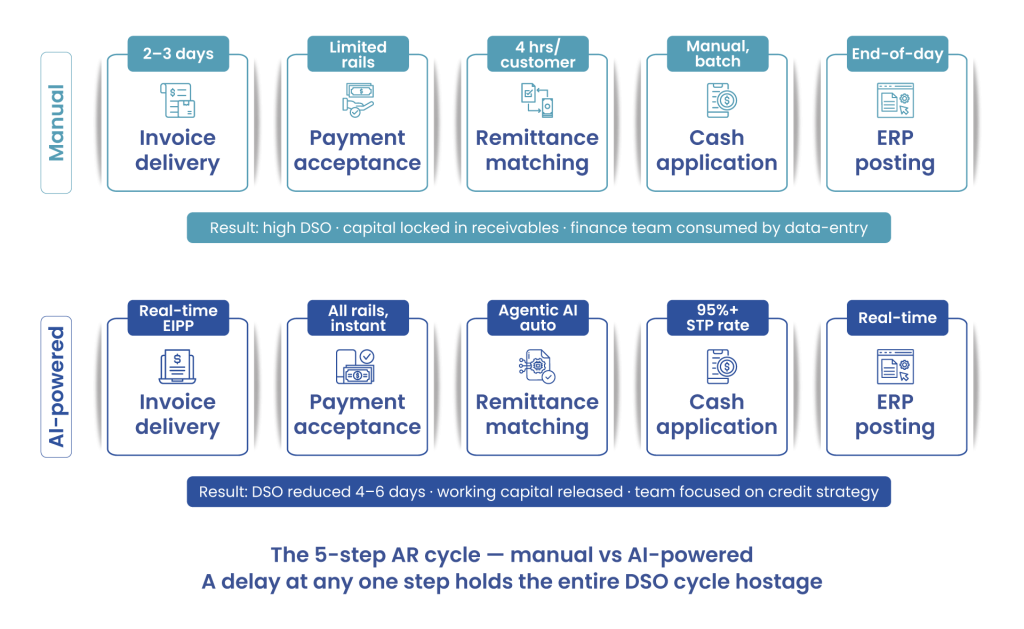
Reducing DSO in a Fortune 500 environment means compressing time across five distinct steps — and a delay at any one of them holds the entire cycle hostage:
◆ Invoice delivery
An invoice that sits in a distributor’s inbox for two days before they open it cannot be paid today. Real-time digital presentment eliminates this delay entirely.
◆ Payment acceptance
Supporting only one or two payment rails forces buyers to adapt to the seller — creating friction that directly delays payment initiation.
◆ Remittance matching
Payments arriving without structured remittance data stall in a manual queue. Without automation, each one consumes hours before it can be applied.
◆ Cash application
Matching payments to open invoice lines across partial payments, deductions, and multi-invoice remittances is where most enterprise AR teams lose the most time.
◆ ERP posting
A matched payment that sits in a batch queue for end-of-day posting has not yet improved working capital — regardless of when the bank received the funds.
This is why AI-powered AR automation — the kind that operates across all five steps simultaneously — produces DSO outcomes that piecemeal solutions cannot. Digitising invoice delivery alone does not move the needle if reconciliation still takes four manual hours per customer per week, as it did at 3M India before deployment. The ceiling is always where the manual process survives.
Where Traditional AR Processes Fail Enterprise Teams
Enterprise AR teams are not failing because they lack effort — they are failing because their tools were designed for a different era of B2B commerce.
The standard AR stack at a large enterprise in 2026 still centres on an ERP system built for transaction recording, supplemented by spreadsheets for ageing analysis, email for customer communication, and a manual bank reconciliation process for payment matching. This configuration made sense when invoice volumes were lower, distributor networks were smaller, and payments arrived through predictable channels.
At Fortune 500 scale, those assumptions collapse. A 5,000-dealer network — like Bridgestone’s before deploying Global PayEX’s FreePay — generates invoice and payment volumes that overwhelm any manual reconciliation process. When digital collections stood at 22% pre-deployment, 78% of dealer payments were arriving through manual channels: paper, phone, and unstructured bank transfers. Each required human intervention to match, post, and verify.
The result is a compounding productivity trap. 3M India’s shared services team was spending an average of four man-hours per direct customer per week on remittance-to-cash-application processing alone — not because the team was inefficient, but because the data was unstructured and the volumes were enterprise-scale.
📊 Research Highlight
Manual invoice processing costs enterprises $12–$35 per invoice.
AI-powered automation reduces this to $1–$5. For an enterprise processing 100,000 invoices annually, the cost difference exceeds $700,000 per year — before accounting for the DSO impact on working capital.
Source: Institute of Finance and Management (IOFM), 2025
The deeper problem is that manual AR creates a visibility gap — not just an efficiency gap. Without real-time payment status, CFOs are forecasting cash positions from data that is days or weeks stale. At Stanley Black & Decker’s scale, operating across Asia-Pacific with channel partners in multiple markets, that visibility gap directly constrained how effectively the treasury team could deploy capital.
How AI-Powered AR Automation Cuts DSO at Enterprise Scale
3.1 — Digital Invoice Presentment Eliminates the First Bottleneck
The single fastest DSO reduction lever at enterprise scale is compressing time-to-invoice-delivery to zero. Electronic Invoice Presentment and Payment (EIPP) platforms deliver invoices to distributors the moment they are generated in the ERP, with all commercial terms embedded — credit limits, due dates, payment instructions — eliminating the 2–3 day delay that characterised paper and email-based delivery. For Stanley Black & Decker across Asia-Pacific, this meant channel partners could see, review, and initiate payment on invoices in real time. Combined with automated payment acceptance across ACH and digital payment rails, 90% of collections shifted to electronic channels.
3.2 — Automated Cash Application Eliminates the Second Bottleneck
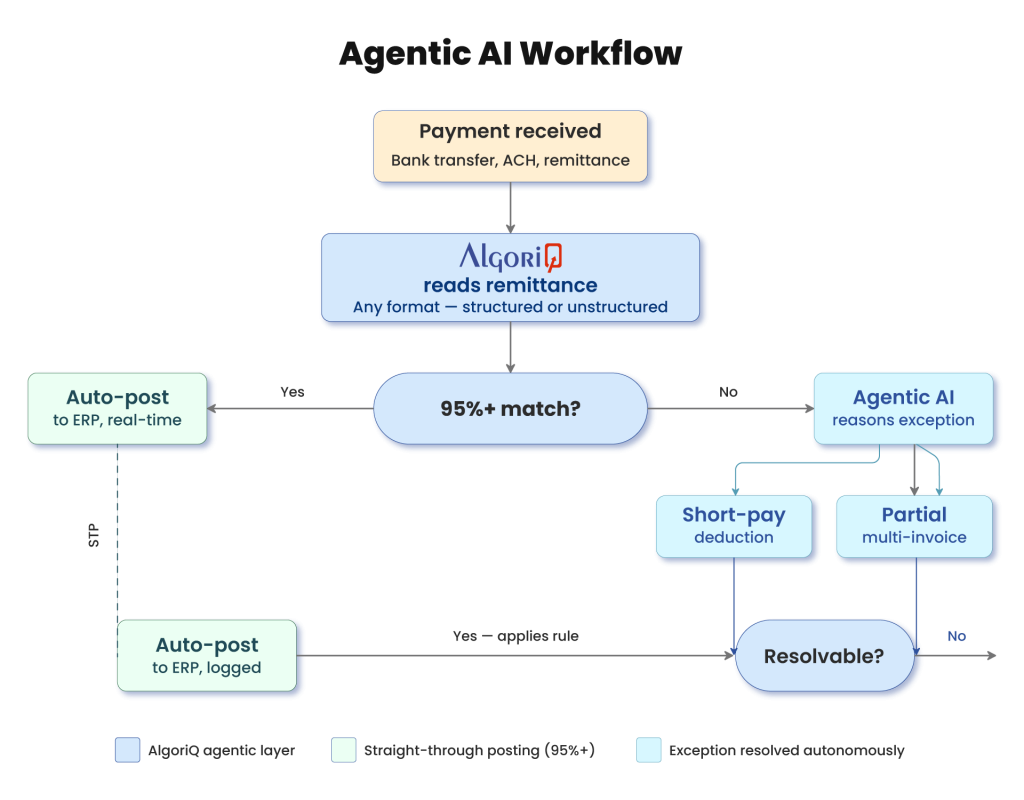
In high-volume distributor networks, cash application is where DSO improvement most frequently stalls. Without automation, finance teams receive unstructured bank data, PDF remittance advices, and sometimes no remittance at all, and must manually reconcile each payment to open invoice lines. At 3M India, this was consuming four man-hours per direct customer per week across their shared services team — not because the team was inefficient, but because the data was unstructured and the volumes were enterprise-scale.
What separates the latest generation of cash application engines — including AlgoriQ’s agentic AI capabilities — from earlier rule-based systems is autonomous exception handling. Rather than routing unmatched payments, short-pays, and deductions to a human queue, agentic AI reasons through these exceptions independently, applying learned business rules and escalating only where genuine ambiguity exists. The system does not wait for instructions. It acts, records its reasoning, and moves to the next transaction. At scale, this is the difference between a 60% match rate that still requires a full reconciliation team and a 95%+ straight-through posting rate that frees that team for higher-value work.
For 3M India, this shift from reactive to autonomous processing reduced DSO by four days. What appears to be a modest number has significant working capital implications at Fortune 500 revenue scale — four days of DSO reduction represents hundreds of millions of dollars in released liquidity.
3.3 — Dealer Portal Adoption Closes the Loop
The most underestimated factor in sustainable DSO reduction is buyer experience. An AR automation system that finance teams love but channel partners avoid will not move the DSO needle. Bridgestone India’s deployment illustrates this: 75% of their 4,500 dealer network adopted FreePay’s self-service portal — not through enforcement, but through an experience that made payment simpler than the manual alternative. Digital collections rose from 22% to 80%. That outcome was dealer adoption, driven by usability.
| Capability | Manual / Legacy AR | AI-Powered AR Automation |
|---|---|---|
| Invoice delivery time | 1–3 days (email/paper) | Instant (real-time EIPP) |
| Remittance-to-cash-application | 2–4 hours per customer | 95%+ straight-through posting |
| Dealer / buyer portal | None | Self-service, mobile-enabled |
| ERP posting | Manual, batch | Automated, real-time |
| DSO visibility | Lagging (end-of-period) | Real-time dashboard |
| Working capital forecasting | Estimate-based | Actuals-based |
| Scale without adding headcount | ❌ Not possible | ✅ Platform scales with volume |
The DSO Trap
Improving DSO by 5 days at a company with $500M in annual revenue releases approximately $6.85M in working capital — without new customers, new products, or new financing. Most enterprises carry that capital tied up in receivables year after year, treating high DSO as operational reality rather than a solvable problem.
Calculation: ($500M ÷ 365) × 5 days = $6.85M
The Business Case: What CFOs Need to Take to the Board
The ROI of AI-powered AR automation is not theoretical — it is calculable before deployment. The business case rests on four measurable levers: working capital released from DSO reduction, cost eliminated from manual processing, headcount redeployed from data-entry to strategic work, and revenue risk reduced from reconciliation errors and disputes.
Working capital is typically the largest lever, and the most immediate. At Bridgestone India, the €7 million released over nine months was not a projected benefit — it was a measured outcome, tracked against the CFO’s own pre-deployment baseline. At Stanley Black & Decker, the $1.1 million unlocked came directly from the cash conversion cycle compression that FreePay enabled across their Asia-Pacific channel network.
The implementation timeline matters to the business case. Global PayEX’s pre-built ERP connectors mean most deployments go live within 2–4 weeks for initial onboarding, with platform performance maturing over the following 3–6 months. This compresses the payback period to under one year in most enterprise deployments — a return profile that survives CFO scrutiny.
Evaluation Guide: What Enterprise CFOs Should Ask Every AR Automation Vendor
Before committing to an AR automation platform, put these questions directly to every vendor on your shortlist:
◆ Does the platform operate natively inside your ERP?
Point solutions that sit outside your SAP, Oracle, or NetSuite instance require data synchronisation — and synchronisation means latency, failure points, and reconciliation overhead. Ask vendors to demonstrate direct ERP write-back, not just export capability.
◆ What is the actual straight-through cash application rate on your customer data?
Most vendors cite industry averages. Ask them to demonstrate their matching engine on a sample of your own remittance files, across the formats your customers actually use. The gap between benchmark and actual is where implementations fail.
◆ What does dealer or buyer portal adoption look like — and how is it measured?
DSO reduction at scale requires your channel partners to change behaviour, not just your internal team. Ask for adoption rate data from comparable distributor networks. Bridgestone India reached 75% active portal adoption across 4,500 dealers — that is the benchmark worth asking about.
◆ How does the platform handle multi-entity, multi-currency reconciliation?
Fortune 500 treasury teams operate across legal entities, currencies, and banking relationships simultaneously. A platform that handles single-entity AR well may not scale to global shared services. Ask for a live demonstration across two or more entities with different base currencies.
◆ What is the implementation timeline and what does support look like during the first 90 days?
The first 3 months of any AR automation deployment are where adoption succeeds or quietly fails. Ask vendors specifically what their onboarding process includes — dedicated customer success, training for distributor portal users, and escalation paths when matching rates underperform.
◆ Can the platform generate the KPI reports your board and treasury team need?
DSO trending, working capital movement, exception queues, dispute ageing — these outputs drive the business case forward after go-live. If the reporting layer requires custom development, that is a red flag.
What This Means for Your Finance Team
The conversation about AR automation and headcount tends to generate more anxiety than it deserves — and usually misses the real question, which is not “how many people do we need?” but “what should those people be doing?”
When AlgoriQ handles remittance matching and AlgoriQ’s agentic layer manages exception resolution autonomously, the profile of work inside an AR team changes in three specific ways:
◆ Collections analysts shift from data-entry to judgment.
Instead of interpreting unstructured bank statements and manually applying payments, analysts manage the small percentage of transactions that genuinely require human reasoning — complex disputes, high-value deductions, relationship-sensitive escalations.
◆ Credit risk managers gain a real-time signal, not a lagging report.
When payment behaviour data flows into the ERP in real time, credit decisions are no longer made on week-old ageing reports. Risk assessments reflect what is actually happening in the customer base today.
◆ Treasury leaders forecast from actuals, not estimates.
Cash position visibility shifts from a periodic reconciliation exercise to a live dashboard. Working capital deployment decisions become more confident — and more frequent.
None of this is automatic. It requires deliberate process redesign — redefining team roles, recalibrating KPIs away from transactions processed toward outcomes driven, and investing in change management for both internal staff and the channel partners who interact with the new buyer portal. The software creates the headroom. What the organisation does with it is a leadership decision.
The Global PayEX Approach
Global PayEX operates two core platforms for enterprise AR automation — FreePay and AlgoriQ — designed to work together across the full order-to-cash cycle, or deployed independently depending on where a finance team’s biggest constraint sits.
◆ FreePay — Electronic Invoice Presentment & Payment (EIPP)
Delivers invoices to channel partners in real time with all commercial terms embedded. Supports multi-currency, multi-bank payment acceptance across ACH, NEFT, RTGS, UPI, and digital payment rails. Includes a self-service dealer portal that is mobile-enabled and built around the buyer’s payment experience — not just the seller’s workflow.
◆ AlgoriQ — Agentic AI Cash Application
Reads remittance data in any format — structured or unstructured — maps to open invoice lines, handles deductions and partial payments autonomously, and posts directly to SAP, Oracle, NetSuite, and other major ERPs. Achieves 95%+ straight-through cash posting rates.
◆ ERP Integration — Pre-built, No Custom Development
Pre-built connectors for SAP, Oracle, and NetSuite mean most deployments go live within 2–4 weeks. The platform writes back to the ERP in real time — no parallel data environments, no synchronisation overhead, no reconciliation between systems.
◆ Enterprise Architecture — Multi-entity, Multi-currency, Multi-bank
Designed for Fortune 500 treasury operations that span legal entities, currencies, and banking relationships. The same deployment that serves a single business unit scales to a global shared services centre without re-implementation.
◆ Scale — $50B+ Processed, 60+ Enterprise Customers
Global PayEX has processed over $50 billion in B2B transactions since 2015 across manufacturing, FMCG, industrial, and tools and storage sectors in Asia and the US — including the three Fortune 500 deployments documented in this report.
See What AI-Powered AR Automation Would Unlock for Your Business
Use Global PayEX’s DSO Savings Calculator to model the working capital impact specific to your revenue and current DSO — before any commitment. Or speak with an AR automation specialist about your ERP environment.
→ Calculate Your DSO Savings → Book a Demo
Fortune 500 in Practice: Three Deployments, Three Outcomes
Case Study · Tools & Storage · Asia-Pacific | Fortune 500
Stanley Black & Decker Unlocks $1.1M in Working Capital Through 50% Faster Cash Conversion
Before
Stanley Black & Decker’s treasury team across Asia-Pacific was managing channel collections through predominantly manual processes — paper invoices, manual payment follow-ups, and reconciliation workflows that consumed significant finance team bandwidth. Their objective: reduce DSO, increase sales team productivity, and cut the total cost of collections and reconciliation across a multi-country distributor network.
What Changed
Global PayEX deployed FreePay across SBD’s Asia-Pacific channel network, digitising invoice presentment in real time, embedding commercial terms and credit limits directly into the payment flow, and automating the reconciliation cycle back to ERP.
Results
✓ 90% of collections shifted to electronic channels
✓ $1.1 million in working capital unlocked
✓ Cash conversion cycle accelerated by 50%
“Global PayEX’s fintech-powered solution has fully digitized our workflows, alleviating our treasury team from traditional manual practices to better focus on core strategy planning, to further grow the business.“
— Jessica Chan, Director of Treasury APAC, Stanley Black & Decker
Case Study · Industrial Manufacturing · India | Fortune 500
3M India Reduces DSO by 4 Days and Eliminates Manual Reconciliation Across Distributor Network
Before
3M India’s AR function relied on a large shared services team to complete financial accounting and cash application processes for their distributor network. Processing remittance-to-cash-application for direct customers consumed an average of four man-hours per customer per week. The objective: automate ACH-based direct debits, eliminate manual reconciliation errors, and bring transparency to the collections process.
What Changed
Global PayEX’s FreePay digitised invoice presentment and automated payment processing for 3M India’s distributor network, with end-to-end account reconciliation handled directly through the platform. The shared services team’s manual matching workload was replaced by automated cash posting to the ERP.
Results
✓ DSO reduced by 4 days
✓ Significant reduction in reconciliation time and manual effort
✓ End-to-end AR digitisation across distributor base
“3M India has successfully deployed Global PayEX’s FreePay solution to improve the efficiency in our collection and account receivable management. FreePay digitized our invoice presentment, automated payment processing and took care of our end-to-end customer account reconciliation. Our dealers have appreciated the solution for its completeness, ease of use and transparency in doing business.“
— Ranjan Choudhury, Credit Risk Manager, Asia Global Credit Risk Management COE, Treasury — 3M India
Case Study · Automotive / Tyre Manufacturing · India | Fortune Global 500
Bridgestone India Unlocks €7 Million in 9 Months and Cuts DSO by 6 Days Across 4,500-Dealer Network
Before
Bridgestone India’s 5,000+ dealer network was managed through a manual collection and reconciliation process that was limiting both productivity and working capital efficiency. Pre-deployment, digital collections stood at just 22% — meaning the vast majority of dealer payments were arriving through manual, unstructured channels, creating a visibility gap that constrained cash flow forecasting and capital deployment.
What Changed
Global PayEX deployed FreePay across Bridgestone’s dealer network, providing dealers with a self-service portal for invoice viewing, payment initiation, and account reconciliation — supported across Bridgestone’s multi-bank environment. Within nine months, 75% of 4,500 dealers were actively using FreePay.
Results
✓ €7 million in working capital unlocked in 9 months
✓ DSO reduced by 6 days
✓ Digital collections: 22% → 80%
✓ Reconciliation speed doubled (2× acceleration)
✓ 99% accuracy in working capital utilisation
“Our digital collections went from 22% pre-COVID-19 to 80% today. We unlocked around €7 million in cashflows over a 9-month period by adopting FreePay. We have reduced our days sales outstanding — the average time taken to get paid after invoicing — by 6 days.“
— Jyotsna Sharma, Chief Financial Officer, Bridgestone India
Conclusion
The CFOs at Stanley Black & Decker, 3M, and Bridgestone did not implement AR automation to run a more efficient back office. They did it to change what their finance teams could see, decide, and act on — and to recover capital that was sitting in the receivables ledger doing nothing. The benchmark these deployments set is not aspirational. It is operational, documented, and repeatable. The question for every enterprise CFO still running manual AR in 2026 is not whether AI-powered automation delivers. It is how many quarters of working capital they can afford to leave on the table while deciding.
Find Out What Your Receivables Are Actually Costing You
Model the DSO and working capital impact for your business using Global PayEX’s free calculator — or speak with an AR automation specialist about your ERP environment and distributor network.
→ Calculate Your DSO Savings → Book a Demo
Frequently Asked Questions
What is AI-powered AR automation and how does it reduce DSO?
AI-powered AR automation uses machine learning to digitise and automate the full accounts receivable cycle — invoice presentment, payment acceptance, cash application, and ERP reconciliation — without manual intervention at each step. By eliminating delays in invoice delivery, remittance matching, and cash posting, it compresses the time between billing and payment receipt. Fortune 500 companies including 3M India and Bridgestone India have used AI-powered AR automation to reduce DSO by 4 and 6 days respectively, releasing significant working capital within the first year of deployment.
How much working capital can an enterprise unlock through AR automation?
The working capital released depends on current DSO, revenue scale, and the degree of automation achieved. A useful benchmark: every day of DSO reduction releases approximately 0.27% of annual revenue in working capital. Bridgestone India unlocked €7 million over nine months by reducing DSO by 6 days. Stanley Black & Decker unlocked $1.1 million through a 50% improvement in cash conversion cycle efficiency. At $500M annual revenue, a 5-day DSO reduction releases approximately $6.85 million — a figure that in most enterprise contexts exceeds the total cost of the automation investment.
How does AI-powered AR automation integrate with SAP, Oracle, or NetSuite?
Enterprise AR automation platforms like Global PayEX’s FreePay and AlgoriQ use pre-built ERP connectors that write back directly to the ERP without requiring custom code. Invoice data originates in the ERP, payment and reconciliation data posts back in real time, and the platform operates as an intelligent layer over the existing system. Most implementations go live within 2–4 weeks for initial configuration, with full performance maturity developing over the following 3–6 months.
How long does AR automation implementation take at Fortune 500 scale?
With pre-built ERP connectors, the technical integration component of a Global PayEX deployment typically completes within 2–4 weeks. Distributor portal onboarding — the stage that drives DSO outcomes — runs in parallel, with active dealer adoption building over the first 60–90 days. Full platform performance, including ML-based cash application match rates reaching 95%+, typically matures over the first 3–6 months. Bridgestone India achieved its €7 million working capital outcome within 9 months of full deployment.
What is the difference between EIPP and full AR automation?
EIPP — Electronic Invoice Presentment and Payment — covers invoice delivery and payment acceptance: the front end of the AR cycle. Full AR automation extends this to include automated cash application, dispute management, ERP reconciliation, and real-time reporting. EIPP alone can accelerate payment receipt; full AR automation is what reduces DSO sustainably and eliminates the reconciliation overhead that consumes finance team capacity at enterprise scale.
Does AR automation work differently in Asia versus the US?
The core automation architecture is the same, but the payment infrastructure context differs. In Asia — particularly India — the distributor network model is dominant, with large numbers of channel partners making frequent, smaller payments across multiple payment rails (NEFT, RTGS, UPI). In the US, ACH direct debit and electronic bank transfer are the primary mechanisms. Global PayEX’s FreePay is designed for both contexts: multi-currency, multi-bank, and multi-payment-rail by architecture. Stanley Black & Decker and Bridgestone India demonstrate the Asia deployment model; 3M India demonstrates cross-regional deployment including NACH(ACH) automation.