

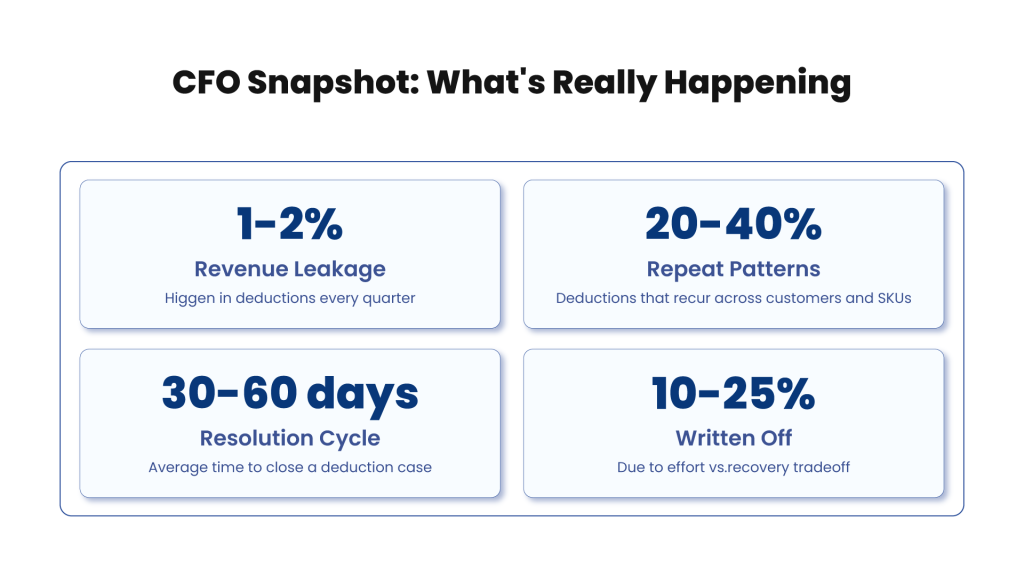
In Chemicals and EMS, 1–2% of revenue is quietly lost every quarter — not through bad sales, but through deductions that go unexamined.
A delayed pricing index. A mismatched BOM. A disputed freight charge.
Individually, these look operational. Collectively, they erode EBITDA, distort working capital, and mask revenue truth.
This is not an AR problem anymore.
This is a revenue governance problem.
Why Chemicals and EMS Are Structurally Prone to Deduction Complexity
These sectors do not suffer from “process inefficiency.” They operate within volatility by design.
Chemicals
Pricing often floats with commodity indices. When index updates and billing engines fall out of sync, disputes emerge at scale. Add fuel surcharges, compliance penalties, distributor rebate layers, and lab-validated quality claims — and deductions become systemic, not incidental.
EMS
Component price revisions move rapidly through global supply chains. BOM adjustments ripple across invoices. OEM contracts embed yield thresholds and SLA-linked penalties directly into revenue recognition logic.
An EMS enterprise managing thousands of SKUs across geographies does not experience deductions occasionally. It experiences them continuously.
The issue is not volume. The issue is intelligence.
The Silent Financial Risk No Dashboard Shows
ERP systems record deductions.
They do not interpret, cluster, or prevent them.
Most ERP systems — whether SAP S/4HANA, Oracle NetSuite, or Microsoft Dynamics 365 — were built to record transactions, not to reason through them. So, organizations build parallel processes:
- Finance investigates
- Sales negotiates
- Operations validates shipping
- Quality reviews claims
Weeks pass. Cases close. Another batch arrives.
No clustering. No systemic prevention. No probabilistic recovery modeling.
Over time, 1–2% recurring leakage quietly embeds itself into EBITDA. Not because the organization lacks effort. Because it lacks interpretive infrastructure.
Case Insight: When Complexity Becomes Structural Leakage
Consider a mid-sized global EMS manufacturer producing control boards for three major OEMs.
Component pricing for a critical semiconductor shifts twice in one quarter due to supply chain constraints. The procurement team updates cost sheets, but billing system rules lag by three weeks.
Invoices go out at prior pricing. OEMs short-pay in alignment with updated contract clauses. Finance opens 240 deduction cases across two months. Each case requires contract validation, BOM reconciliation, and pricing proof.
By the time 70% are resolved, the organization writes off a portion — not because the claim is valid, but because resolution cost outweighs recovery effort.
Total margin impact: 1.4% of quarterly revenue.
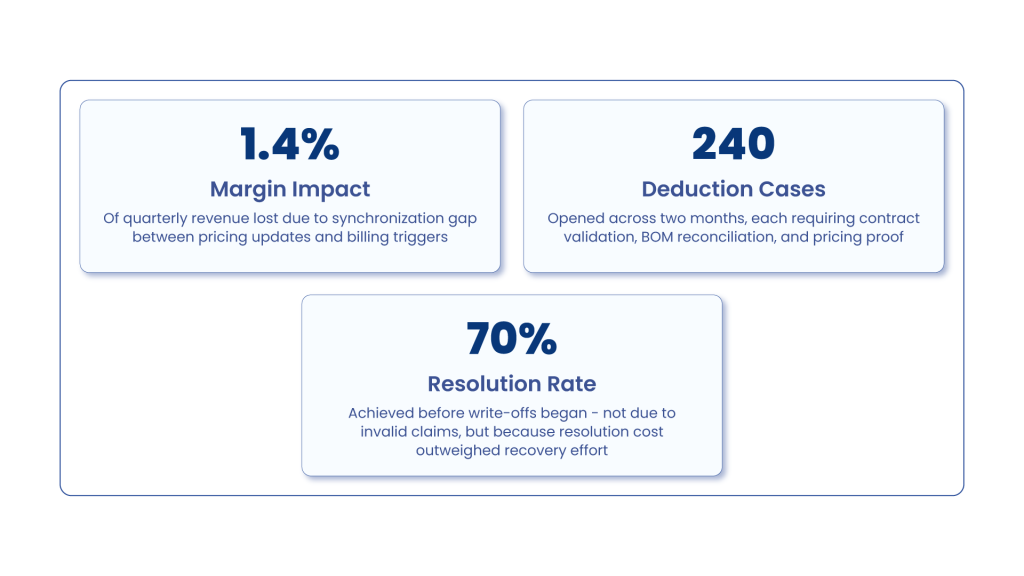
The root cause? A synchronization gap between pricing updates and billing triggers. The organization resolved deductions. It did not prevent them.
This is where AI changes the equation.
The AI Inflection Point: From Resolution to Interpretation
The shift in 2026 is not about faster workflows. It is about layered intelligence. Three technological shifts are redefining how forward-looking enterprises operate:
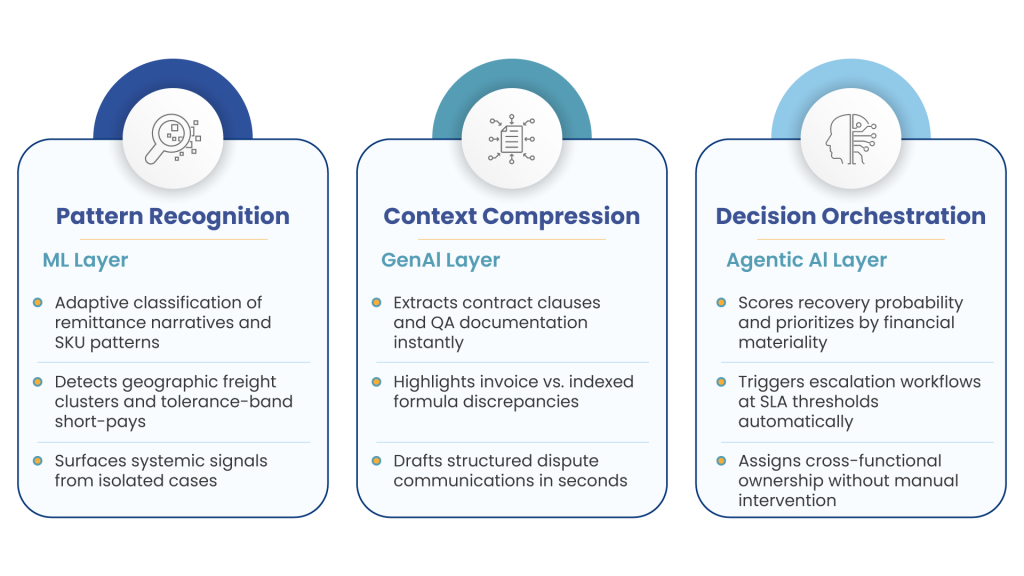
Machine Learning for Pattern Recognition at Scale
Machine learning models analyze remittance narratives, customer behavior, SKU-level patterns, and historical dispute outcomes. Instead of static reason codes, they generate adaptive classifications that evolve over time.
Patterns emerge:
- Freight disputes clustering in a specific geography
- Distributor short-pay behavior within tolerance bands
- Pricing mismatches tied to commodity index timing
What once appeared as isolated cases reveals systemic signals. This enables finance teams to identify recurring freight disputes by region, detect distributor-level short-payment behavior, and cluster pricing mismatches tied to commodity volatility.
Pattern recognition reduces ambiguity — and ambiguity is what slows recovery.
Generative AI for Context in Seconds, Not Days
GenAI systems reduce investigative drag.
Deduction disputes in Chemicals and EMS are documentation-heavy. Contracts, QA reports, shipment proofs, SLA clauses, pricing schedules — these must be reviewed before resolution.
GenAI systems:
- Extract relevant contract clauses instantly.
- Summarize QA documentation.
- Highlight discrepancies between invoice price and indexed contract formula.
- Draft structured dispute communication aligned to legal language.
Rather than manually navigating 40-page agreements, finance teams receive contextual summaries within seconds.
This does not replace human judgment. It enhances it.
Agentic AI for Autonomous Financial Workflow Orchestration
The most transformative layer is agentic AI.
Agentic systems do not simply automate tasks; they evaluate context, learn from outcomes, and recommend decisions. They can assess recovery probability based on historical success rates, trigger escalation workflows based on SLA thresholds, and prioritize cases based on financial materiality.
In practice, this means:
- High-probability recovery disputes are surfaced first
- Low-value write-offs are processed efficiently
- Cross-functional ownership is assigned automatically
Deduction management shifts from reactive coordination to autonomous orchestration.
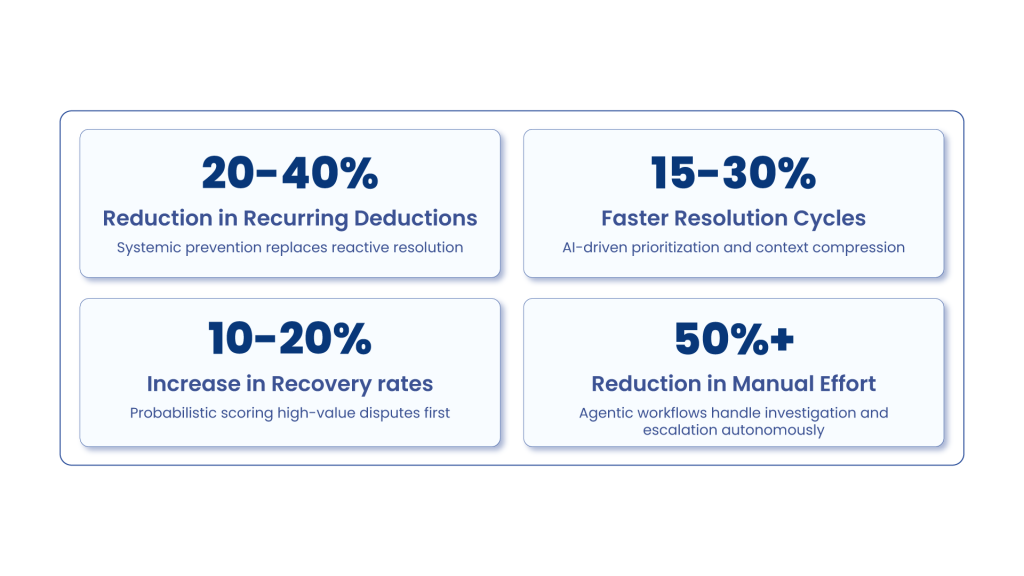
Business Impact of Deduction Intelligence
Organizations implementing AI-led deduction intelligence typically see measurable, compounding returns across the revenue lifecycle:
Why This Matters More Now
Three macro realities make AI-driven deduction management critical in 2026:
01. Supply chain volatility is no longer episodic — it is permanent. Commodity instability and geopolitical disruptions have normalized pricing unpredictability.
02. EMS margins remain structurally tight. Even marginal deduction leakage can materially impact EBITDA.
03. CFOs increasingly demand real-time working capital intelligence. Static AR reports no longer suffice. Leadership wants predictive visibility — not historical summaries.
Deduction data, when intelligently analyzed, becomes a forward-looking signal of financial health.
What Forward-Looking CFOs Now Measure
The CFO mandate is changing. CFOs are no longer satisfied with DSO reduction alone. In mature organizations, the KPI conversation has evolved beyond DSO.
They are asking sharper questions:
Preventability
- What percentage of deductions are preventable?
Customer Behavior
- Which customers systematically exploit tolerance thresholds?
Internal Misalignment
- Where are we writing off value due to internal misalignment?
Receivables Quality
- How predictive is our receivables quality?
They are now examining:
- Deduction recovery rate as a percentage of disputed value
- Resolution cycle velocity
- Repeat deduction clustering by customer
- Root cause heatmaps by SKU or contract type
- Deductions as a percentage of total revenue
These metrics reflect operational intelligence — not just financial lag indicators.
The Emerging Role of Revenue Intelligence Platforms
This is where the conversation extends beyond standalone deduction modules.
Platforms such as Global PayEX embed AI-driven classification, workflow orchestration, and recovery analytics directly into existing AR ecosystems — without replacing core ERP infrastructure.
The objective is not to add complexity. It is to reduce friction across the revenue lifecycle.
For Chemicals and EMS enterprises operating in high-volatility environments, this integrated model provides structural resilience.
A Defining Shift in Finance Architecture
By 2028, deduction intelligence will sit alongside FP&A dashboards. Not as an operational metric. As a strategic revenue integrity indicator.
Because deductions will continue to exist in Chemicals and EMS. Pricing complexity will not simplify. Contracts will not become less layered. In such volatile, contract-heavy sectors, revenue realization cannot depend on manual coordination.
It requires autonomous governance.
The Category-Defining Thesis
Deductions are not accounting friction. They are early warning signals of revenue misalignment.
Dispute Workflow Approach
Enterprises that treat deduction management as a dispute workflow will continue resolving yesterday’s problems.
Revenue Governance Approach
Enterprises that treat deduction intelligence as a revenue governance layer will begin preventing tomorrow’s leakage.
The question is no longer:
‘How fast can we resolve them?’
The real question is:
‘Why are they happening — and how do we stop them at source?’
That is the difference between managing receivables… and governing revenue.
Explore Deduction Intelligence for Your Organization
Whether you are managing 50 or 50,000 deduction cases per quarter, AI-led deduction intelligence delivers measurable impact from day one.
Identify Hidden Revenue Leakage
Uncover recurring deduction patterns across customers, SKUs, and geographies
Benchmark Recovery Performance
Compare deduction recovery rates against industry benchmarks for Chemicals and EMS
See AI Deduction Intelligence in Action
Experience ML classification, GenAI context compression, and agentic orchestration live
Book a 20-min CFO Briefing — See how Global PayEX operationalizes deduction intelligence for Chemicals and EMS enterprises. Request a Demo
FAQs
What is AI-powered deduction management?
AI-powered deduction management uses machine learning, generative AI, and agentic systems to classify, analyze, resolve, and prevent customer deductions — improving recovery rates and working capital visibility.
Why is deduction management critical in Chemicals and EMS?
Both sectors operate with pricing volatility, contract complexity, and supply chain variability. Unmanaged deductions distort revenue visibility and impact profitability.
How does agentic AI improve deduction recovery?
Agentic AI evaluates recovery probability, contract alignment, and historical patterns to prioritize material disputes and automate cross-functional workflows.
Can AI deduction systems work with existing ERP platforms?
Yes. Modern platforms like Global PayEX integrate with all ERP systems across the world like SAP S/4HANA, Acumatica, Sage, Oracle NetSuite, and Microsoft Dynamics 365 and more through overlay architectures without requiring replacement.